

At one trade finance compliance forum in NYC, one of the attendees, a practitioner with a long and successful career in compliance, asked the panelists: “Why are the ones who help our enemies evade sanctions usually our closest allies?” The panel's response mostly addressed technical compliance issues, as the international relations discussion was not the primary goal of that event. But still, why are the US sanctions frequently undermined by firms from the EU, UAE, Saudi Arabia, or Turkey – the countries one would expect to be the most aligned with the US in foreign policy?
Ironically, that day I was just a PhD candidate in a room of prominent professionals, but I was 100% sure that I knew the answer to this question. With research interests in sanctions evasion and, more broadly, third countries’ strategies and choices regarding compliance or circumvention of sanctions, I had no chance of missing the book “Busted Sanctions” by Professor Bryan Early of the University at Albany. And this book has a precise answer to the question. His answer to the eternal question of why sanctions fail – success rate estimates vary from merely 4% (Pape, 1997) to around 35% (Hufbauer et al., 2007, Morgan et al., 2014) – is not only the poor design of sanctions or weak implementation; Early states that there is a significant contribution from third countries and provides substantial supportive evidence to his argument.
Busted Sanctions
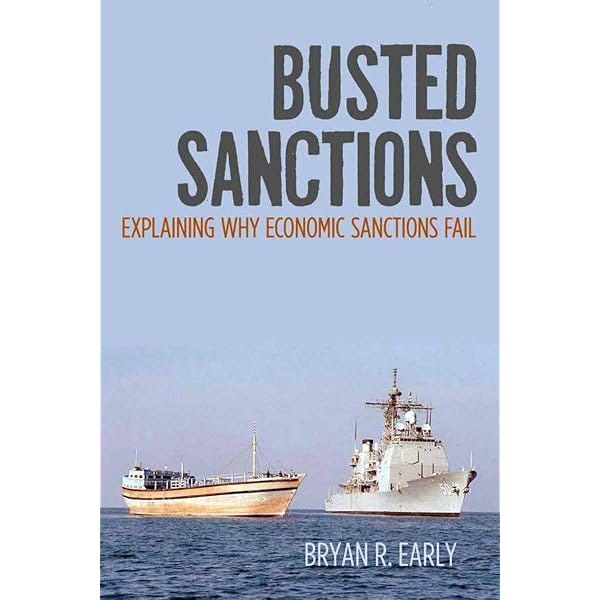
Early identifies two major mechanisms of sanctions busting – aid-based and trade-based. Aid-based sanctions busting is driven by ideology or political interests and conducted at the government level, while trade-based sanctions busting is done by individual firms and motivated by their commercial interests, which makes it a core concern for compliance professionals. By analyzing 96 US sanctions episodes in 1950-2002, Early shows that the most likely sanctions busters are firms from countries with large open economies that have pre-existing trade ties to the target of sanctions and are geographically proximate to it.
Two interesting findings deserve more careful consideration. First, the geographical proximity is twofold. On the one hand, the closer the distance to the target of sanctions, the higher the probability of being involved in circumvention. At the same time, countries that share a physical border with a sanctioned state are more likely to circumvent sanctions through illicit trade, making it less traceable to external analysts. In practice, this means that the absence of official connections or transactions with businesses from a sanctions target, and even official country-level data showing no change in sanctioned goods flows, cannot completely eliminate sanctions risk.
The second important finding is that US allies are twice as likely to circumvent US sanctions as other countries. According to Early’s calculations, in 1950-2002, firms from Germany (West Germany in pre-1990), Japan, Italy, France, and the UK were responsible for almost half of US sanctions circumvention episodes. He digs into case studies of Iran-related sanctions busting and shows that US allies such as Australia, Japan, the Netherlands, France, Italy, and Germany saw increases in their exports to Iran in the 1980s and 1990s ranging from twofold to sixfold.
Moreover, Early provides a detailed study of several waves of US sanctions against Iran and the circumvention of these sanctions through the transshipment of sanctioned goods via the port of Dubai. He illustrates that the Defense Cooperation Agreement between the US and UAE, signed in 1994, significantly intensified the re-export of US goods to Iran through Dubai – even based on the official data, ignoring the smuggling of dual-use goods.
Another insightful case study is the Iraqi invasion of Kuwait and consequent UN sanctions. Emirati traders utilized the established networks and smuggling routes to run goods to Iraq via Iranian waters, even as the UAE's federal government was contributing troops to the US-led coalition against Saddam Hussein. After the Gulf War, when enforcement attention faded, the illegal traffic reversed into oil smuggling out of Iraq via Iran to Dubai and Fujairah, with overall flows out of Iran reaching an estimated 10,000 barrels a day by 1994.
Why do closer ties with the US lead to more disruptive behavior when it comes to sanctions? Early argues that one of the important factors is that the alliance with the US actually gives other countries a kind of protection, a shield against US coercive measures, as the reputational costs for the US would be greater than the loss from flawed sanctions. While he bases this conclusion on the UAE case, the same underlying alliance-shield logic could be easily extended to the Iran-Libya Sanctions Act (ILSA) of 1996, which never really triggered any sanctions against European companies – even the $2 billion investment into a gas field by Total SA of France, Gazprom of Russia, and Petronas of Malaysia received a waiver. On top of that, other foreign investments agreed to in Iran’s energy sector were estimated to total $11.5 billion, although penalties were never imposed.
Finally, to protect EU businesses involved in legitimate trade, the EU introduced the Blocking Statute, which prohibited European persons from complying with foreign sanctions and signaled an important first step in the divergence of legislation between the US and EU. In recent years, this trend has intensified: the US withdrew from the JCPOA in 2018, the EU updated the Blocking Statute, and the mismatch in approaches to Russian sanctions leaves firms to navigate multiple legal frameworks.
Helpful insights
Allied-country origin is not a de-risking factor
Shared border creates pre-conditions for illicit trade
Sanctions evasion background is a strong risk indicator and a reason for scrutiny
Contractual clauses become one of the most crucial sanctions risk controls the company can introduce
Diverging sanctions legislation and blocking statutes create conflicting legal obligations across jurisdictions, giving rise to a new compliance risk
Sources:
Clawson, Patrick. "Sanctions Relief for Iran Without Congressional Approval." The Washington Institute, n.d. Accessed July 26, 2026. https://www.washingtoninstitute.org/policy-analysis/sanctions-relief-iran-without-congressional-approval.
Early, Bryan R. 2015. Busted Sanctions: Explaining Why Economic Sanctions Fail. Stanford University Press.
Hufbauer, Gary Clyde, Jeffrey J. Schott, Kimberly Ann Elliott, and Barbara Oegg. Economic Sanctions Reconsidered. 3rd ed. Washington, DC: Peterson Institute for International Economics, 2007.
Katzman, Kenneth. "The Iran-Libya Sanctions Act (ILSA)." CRS Report for Congress, Order Code RS20871. Updated August 8, 2006.
Morgan, T. Clifton, Navin Bapat, and Yoshiharu Kobayashi. "Threat and Imposition of Economic Sanctions 1945–2005: Updating the TIES Dataset." Conflict Management and Peace Science 31, no. 5 (2014): 541-558.
Pape, Robert A. 1997. "Why Economic Sanctions Do Not Work." International Security 22, no. 2: 90-136.