

Until recent years, the only country in the world utilizing secondary sanctions was the US. In 2023, in response to widespread evasion of anti-Russian sanctions, the EU introduced its “anti-circumvention tool” as part of the 11th sanctions package against Russia, directly threatening third countries for sanctions-busting activities (Article 12f of Regulation (EU) No. 833/2014). It remained dormant until 2026, when the Kyrgyz Republic faced an export ban on certain computer equipment due to re-exporting Common High Priority-listed items to Russia.
Other Central Asian and South Caucasus countries, widely recognized as transshipment hubs, were not directly sanctioned but eventually adjusted their re-export practices to align more closely with Western sanctions. Georgia, which shares a border with Russia, was actively involved in the re-export of luxury cars from the US and the EU to Russia in 2022-2023, after the G7 and the EU imposed a ban on their supply to Russia. In the summer of 2023, shortly after the EU introduced the 11th sanctions package, Georgia banned the re-export of cars to Russia. According to Georgian official data, it led to a dramatic drop in car sales to Russia – from 1,054 in July to 85 in August, 26 in September, and to almost zero afterward.
Did Western cars stop reaching Russian customers? Not really. Sanctions evaders employed several ways to avoid scrutiny by Georgian and Western authorities. The first was a “grey” channel which was discovered by a Georgian journalist Ia Asatiani. She found that cars imported from the US and the EU were transported to the Georgia-Russian border without any registration and then transferred directly across the border without customs clearance.
Another channel, analyzed by Vakhtang Partsvaniya and Erekle Pirveli from Caucasus University in Georgia, is not “grey” in the common sense, as it involves the legitimate export of cars to Armenia, Kazakhstan, and Kyrgyzstan – members of the Eurasian Economic Union (EAEU) along with Russia. Like the EU, it establishes a customs union, meaning goods face customs controls only at the outer border and can move freely between countries afterward, making it a perfect route for sanctions evasion. Borrowing techniques from money launderers, sanctions evaders continue supplying cars to Russia, layering them through “fourth” countries.
Before digging into the data and Partsvaniya and Pirveli analysis, a quick note on the geographical rationale for Georgia to be the first point of Western cars’ entrance to the region. Being the most Western country in Central Asia and the South Caucasus, Georgia is the only state with access to the Black Sea, while other countries are either landlocked or have ports only on the Caspian Sea, which is technically a lake and doesn’t have access to an open ocean. For car shipments, Georgia naturally became the transshipment hub for other countries in the region long before the West implemented sanctions against Russia. However, since 2022, this trend has intensified significantly, raising reasonable suspicions about its business rationale.
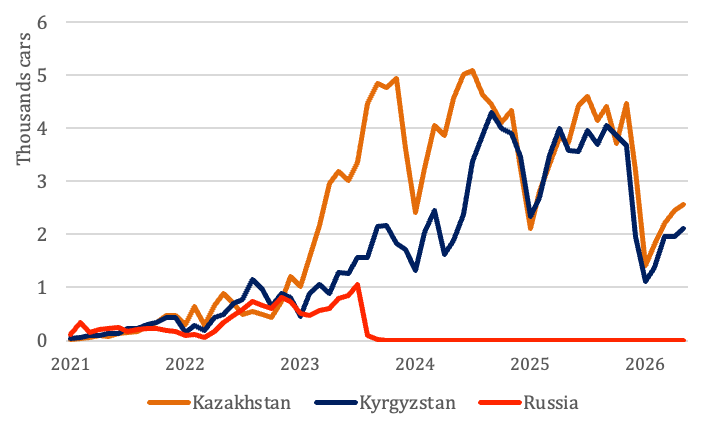
Indeed, while sales to Russia dropped tenfold within the first month after the Georgian ban on car re-export to Russia, supplies to Kazakhstan and Kyrgyzstan expanded from 4,917 in July to 6,047 in August and to 6,900-7,000 in September-October 2023. In 2024-2025, the average export of cars to Kazakhstan and Kyrgyzstan was more than 7,000 cars per month – almost 10 times higher than in any other year before 2022, as shown in Figure 1.
Figure 1. Georgian exports of cars (volume)
Source: National Statistics Office of Georgia
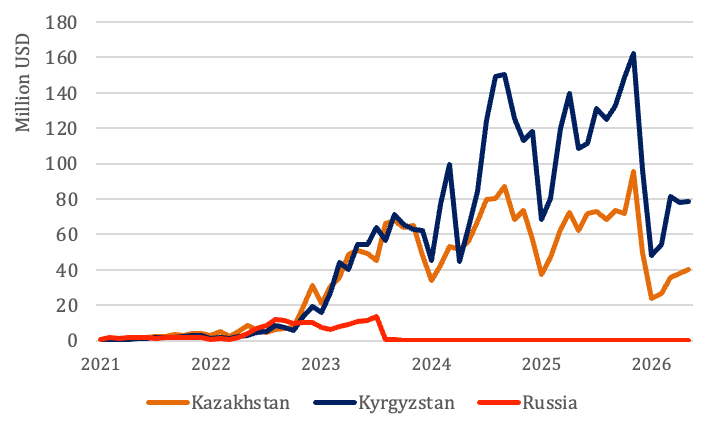
In dollar equivalent, the change is even more impressive. Average monthly exports from Georgia to Kazakhstan and Kyrgyzstan in 2024-2025 exceeded 170 million USD, reflecting more than a 30-fold increase over the pre-2022 period (see Figure 2 below). Surprisingly, Kyrgyzstan appeared to focus on much more expensive cars – if in 2021-2022 the average price of cars exported from Georgia to Kyrgyzstan was about 0.7 of those going to Kazakhstan ($8.3k vs $12.3k), in 2025-2026 this ratio grew above 2.1 ($36.6k vs $17k).
Figure 2. Georgian exports of cars (value)
Source: National Statistics Office of Georgia
Could it be that the demand for cars in Central Asia grew significantly in recent years due to factors unrelated to anti-Russian sanctions – for instance, economic development, partially stimulated by Russian migration in 2022? Not impossible. Partsvaniya and Pirveli test the impact of anti-Russian sanctions on Georgian car exports to the EAEU, controlling for the influence of changes in GDP, inflation rate, and currency exchange rate to account for various mechanisms that can explain demand fluctuations. They find that EAEU members have increased their car imports from Georgia much more than from other Georgia trade partners. An interesting finding outlined by Partsvaniya and Pirveli is that this impact is especially significant in USD terms, relative to volume. They argue that this outcome reflects the elevated logistics and transportation costs associated with rerouting cars through several countries, leaving only luxury-car consumers able to bear them.
Helpful insights
Actual end-user verification is indispensable – just another reminder of what has been known to AML professionals long ago
“No Russia” clause – a contractual commitment barring re-export to Russia or re-export-adjacent use – is essential when trading with EAEU
Trade bloc membership with a sanctioned country or other form of customs relief is a red flag requiring elevated scrutiny
Surging per-unit cost of what has been a regular trade activity, especially when it doesn’t match other trade directions’ dynamics, must be treated as suspicious
Sources:
Council of the European Union. Council Regulation (EU) No 833/2014 of 31 July 2014 Concerning Restrictive Measures in View of Russia's Actions Destabilising the Situation in Ukraine. Consolidated text, July 24, 2026. OJ L 229, 31.7.2014, p. 1. https://eur-lex.europa.eu/legal-content/EN/TXT/?uri=CELEX%3A02014R0833-20260724.
Asatiani, Ia. “Russia’s ‘Auto Heaven.’” iFact. February 13, 2024. https://ifact.ge/en/sanctioned-cars/
National Statistics Office of Georgia. “National Statistics Office of Georgia.” Accessed July 14, 2026. https://www.geostat.ge/en
Partsvaniya, Vakhtang, and Erekle Pirveli. “Western Sanctions Evasion through Third Countries: The Case of Sanctioned Cars Re-export to Russia.” NISPAcee Journal of Public Administration and Policy 17, no. 2 (Winter 2024/2025): 80–108. https://reference-global.com/article/10.2478/nispa-2024-0014