

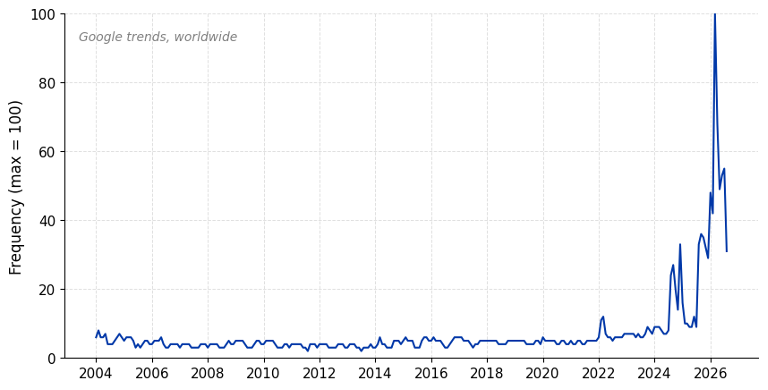
The term “geopolitics” has become one of the central words in recent years. Google Trends search data show it had spikes in the second half of 2024, in mid-2025, and an unprecedented surge at the beginning of 2026 (Figure 1). No other events of the past – even Russia’s full-scale invasion of Ukraine in 2022, marking the largest war in Europe since WWII – produced any comparable growth in common interest in the topic of geopolitics. In January 2026, Kastner, Schive, and Balestin from the World Economic Forum (WEF) stated that “geopolitics took centre stage”.
Figure 1. Google Trends worldwide searches for “geopolitics”
Source: Google Trends
As the world drives toward increasing fragmentation, for businesses with international exposure, understanding the geopolitical risks of the countries where they operate and incorporating geopolitics into their risk assessments has become an essential skill. The big challenge in measuring this risk is identifying how to measure geopolitics. What to look at? How to quantify “politics”? What are the signals that two countries are converging or diverging?
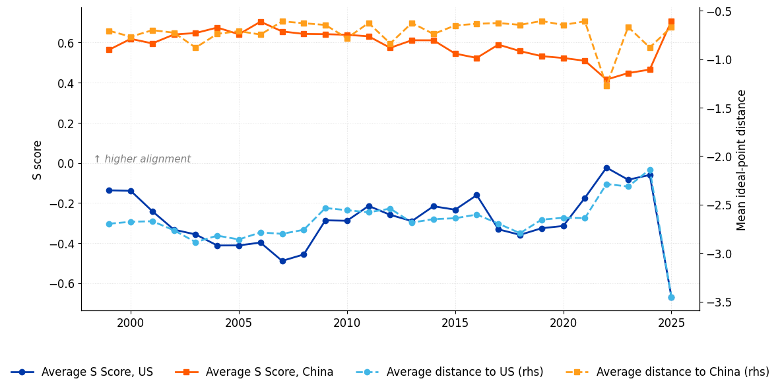
One of the proxies most frequently used by social scientists is the United Nations General Assembly (UNGA) voting alignment. It provides consistent long-term data and is simple to calculate, with only four possible options for all countries: yes, no, abstain, and not vote. The two most popular metrics, S-score and Ideal Point Distance (IPD), calculate the proximity slightly differently – particularly, the Ideal Point Distance works better in terms of acknowledging votes for repeating resolutions – but their performance is mostly similar.
UNGA voting patterns are useful for understanding trends and intertemporal changes. In 2022-2024, the US saw the highest level of the world’s alignment with it in decades, coinciding with the Russian invasion of Ukraine (Figure 2). In 2025, when the Trump administration started the trade war with the whole world, the alignment dropped to a new record low. Directly assessing the overall level of geopolitical alignment of individual countries through UNGA voting is tricky. Both measures (S-score and IPD) indicate that, on average, the world has been much more aligned with China than with the US over the past several decades. It does not, however, allow us to conclude that China has far greater geopolitical power than the US.
Figure 2. UNGA average voting alignment with the US and China
Source: UNGA, Bailey et al. (2017)
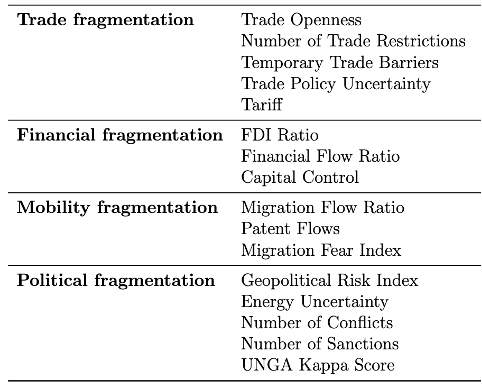
Another proxy to measure countries’ geopolitical proximity is needed. Fernández-Villaverde, Mineyama, and Song, in their 2024 National Bureau of Economic Research (NBER) Working Paper “Are We Fragmented Yet? Measuring Geopolitical Fragmentation and Its Causal Effect,” offer a complex proxy for geopolitical fragmentation (the inverse of proximity). They identify 16 indicators of trade, financial, mobility, and political fragmentation, which can be used to assess overall geopolitical fragmentation at both the global and country-pair levels (Figure 3).
Figure 3. Indicators of Geopolitical Fragmentation
Source: Fernández-Villaverde et al. 2024
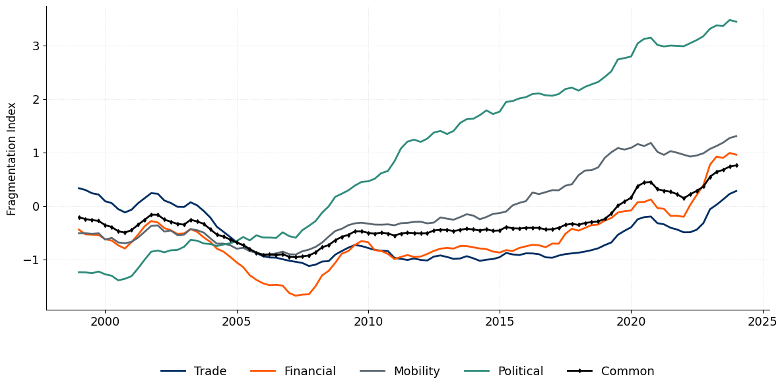
NBER authors use a complex Dynamic Hierarchical Factor Model – a statistical model that allows the extraction and modeling of latent variables that drive the dynamics of observable indicators. Financial fragmentation began to rise steadily after the Global Financial Crisis, accelerating further in the late 2010s and following the Russian invasion of Ukraine. Trade fragmentation remained relatively low until the US-China trade war and, again, the Russian invasion of Ukraine – definitely one of the largest geopolitical events of recent decades. Mobility fragmentation has been gradually surging since 2015, while political fragmentation has been on the rise since the mid-2000s (Figure 4). They also find that global fragmentation was driven by both the US-EU and the Russia-China bloc dynamics – Western restrictive measures (sanctions, trade restrictions, etc.) and Sino-Russian rapprochement may have contributed to it.
Figure 4. Geopolitical Fragmentation Pillars
Source: Fernández-Villaverde et al. 2024
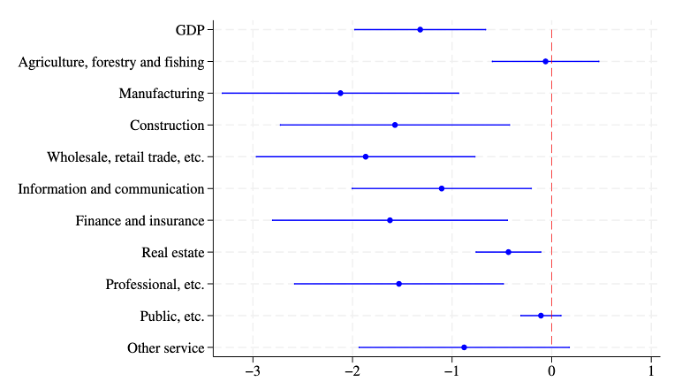
Estimating the impact of 24 major geopolitical shocks, both positive (e.g., the WTO’s creation) and negative (e.g., 9/11), the authors provide evidence that fragmentation and globalization events significantly affect economic growth, industrial production, fixed investment, and stock prices. Also, they estimate the industry-level impact of geopolitical fragmentation on OECD countries and find that some sectors are more resilient to shocks, particularly agriculture, forestry, fishing, as well as the public sector (administration, defense, education, etc.). Manufacturing, trade, finance, and insurance, on the contrary, are the most prone to these shocks (Figure 5).
Figure 5. Geopolitical Shocks Sectoral Impact
Source: Fernández-Villaverde et al. 2024
Geopolitics is on the rise, and no businesses with international exposure can ignore it. Firms have to manage their risks and navigate complex, fast-changing, and often conflicting regulations. On top of that, unforeseen geopolitical shocks, both positive and negative, cause disruption and frequently open new opportunities. Geopolitical risk assessment is the key consideration that enables companies to prepare for and withstand shocks.
Helpful insights:
Industries are impacted by geopolitical shocks differently; some are less prone to them
A broad set of bilateral economic and political indicators map the direction of relations between countries
Negative shocks hit immediately; positive shocks create slower long-term positive impact
Countries outside the major powers (US, EU, China, Russia) frequently enjoy the benefits of global power competition that mitigate the negative shocks
Sources:
Bailey, Michael A., Anton Strezhnev, and Erik Voeten. “Estimating Dynamic State Preferences from United Nations Voting Data.” Journal of Conflict Resolution 61, no. 2 (2017): 430–456. https://doi.org/10.1177/0022002715595700.
Fernández-Villaverde, Jesús, Tomohide Mineyama, and Dongho Song. “Are We Fragmented Yet? Measuring Geopolitical Fragmentation and Its Causal Effect.” NBER Working Paper No. 32638. June 2024. https://doi.org/10.3386/w32638.
Google Trends. “Explore: geopolitics.” Accessed August 19, 2026. https://trends.google.com/explore?q=geopolitics&date=all&geo=US.
Signorino, Curtis S., and Jeffrey M. Ritter. “Tau-b or Not Tau-b: Measuring the Similarity of Foreign Policy Positions.” International Studies Quarterly 43, no. 1 (March 1999): 115–144. https://doi.org/10.1111/0020-8833.00113.
United Nations Dag Hammarskjöld Library. “General Assembly Voting Data Compilation, 1946–2025.” UN Digital Library. Accessed August 19, 2026. https://digitallibrary.un.org/record/4060887?ln=en#files.
World Economic Forum. “Davos 2026: Here Are 5 Key Takeaways of Geopolitics.” January 20, 2026. https://www.weforum.org/stories/geo-economics-and-politics/geopolitics-took-centre-stage-davos-2026-5-key-takeaways/.