

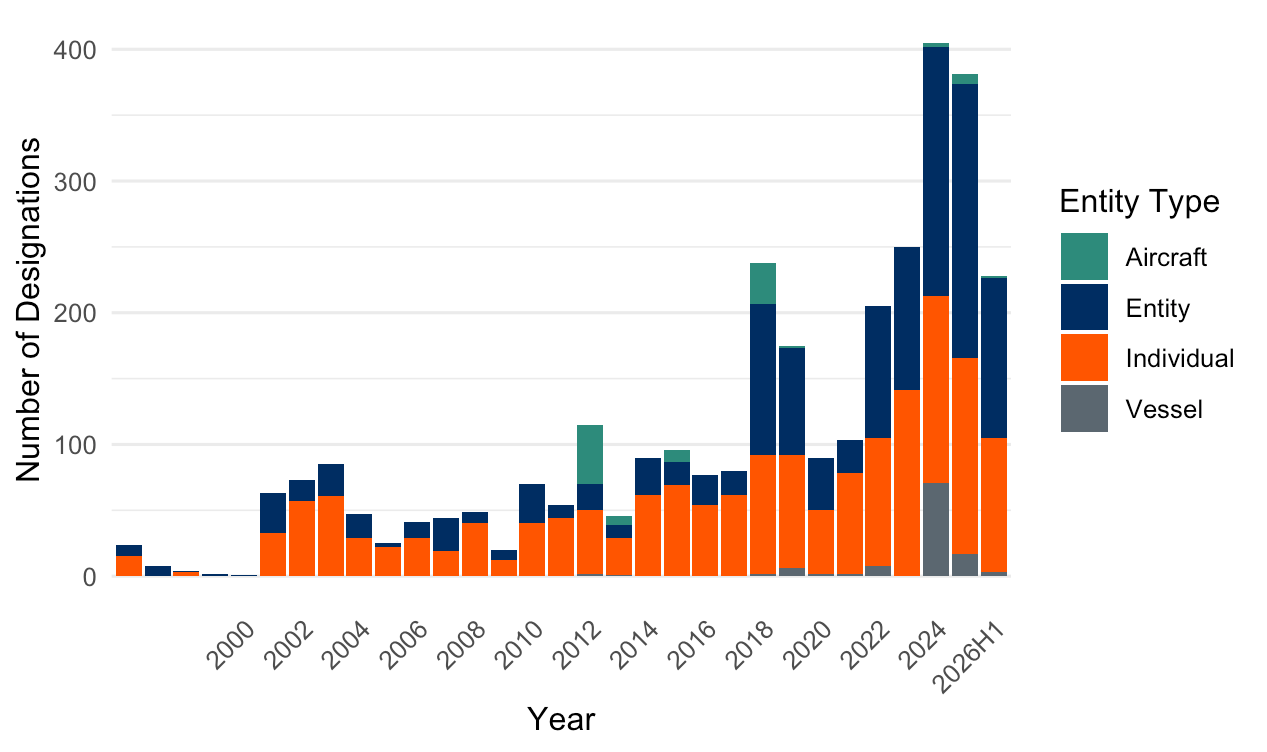
Since Trump returned to the Oval Office in January 2025, the Secretary of State has designated 32 Foreign Terrorist Organizations (FTOs). The number of FTO/SDGT (Specially Designated Global Terrorists) entries on OFAC’s Specially Designated List (SDN) has also been rising in recent years (see Figure 1).
Figure 1. FTO/SDGT designations (SDN list)
Source: OFAC
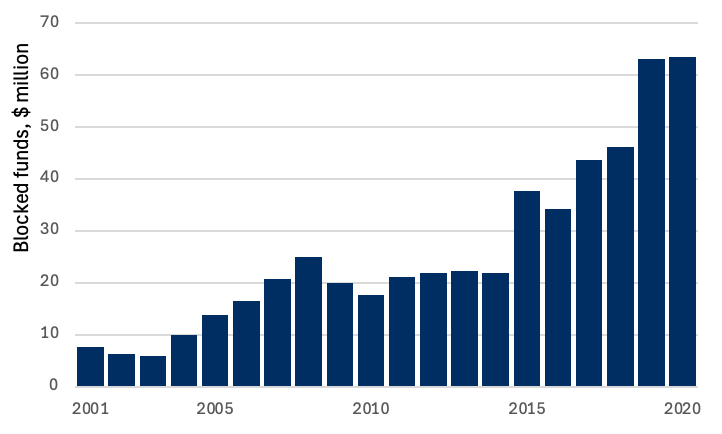
The enforcement of sanctions has also been growing over the years. From 2000 to 2020, according to OFAC’s Terrorist Assets Reports (only available through 2020), the total amount of funds blocked under three major terrorism-related programs grew from $7 million to $63 million (Figure 2), and, given the surge in designations after 2020, one can easily argue the following years might have led to further growth in the blocked funds amount. At the same time, about 36% of the asset freeze stems from Hizballah-related designees, who are solely responsible for nearly $23 million in blocked funds.
Figure 2. Cumulative blocked funds relating to SDGT, SDT and FTO programs (end of year)
Source: OFAC
Unfortunately, this figure alone does not tell us much about whether these sanctions worked. Scholars have studied interstate sanctions for decades, and their findings are not very promising – the most optimistic estimate of sanctions’ success rate was reported by Morgan et al. (2023), which found an average rate of 42%. One of the core caveats is defining “success”. It is naturally affected by the desired outcome of sanctions. If sanctions are imposed to stop the war – which they rarely do – it is a much more complicated task to achieve compared to a smoother goal, such as the release of one prisoner.
Sanctions against FTOs resolve this caveat, as the KPI is clear – whether FTOs reduce the number of their attacks as a result of sanctions. This question is studied by Jo et al. (2026), who analyze 80 groups on the US FTO list for the period 1997-2019, dividing them into three waves:
initial designations (1997–2001) – 38 FTOs;
second generation (2001-2011) – 28 al Qaeda associates;
third generation (2011-2019) – 14 Islamic State (IS) affiliates.
Of course, financial sanctions are often accompanied by military actions and other factors, such as host-government enforcement and internal organizational changes. By controlling for these factors, the authors of the article identify instances in which sanctions themselves led to a decrease in terrorist activity.
Obviously, FTOs differ from one another, and averaging them will not yield a reliable finding. Money is essential for terrorism. An FTO sponsored by a single actor (whether a state or a private donor) and a group that relies on profits from criminal activities would have different availability to continue financing their attacks. To divide FTOs into reasonable categories, the authors of the article analyze the financial adaptability of terrorist groups by assessing their autonomy (direct control over resources), diversification (number of funding sources), and invulnerability (reliance on the global financial system or informal channels).
In the first generation of FTOs (1997-2001), only 4 out of 38 groups exhibited a high level of financial adaptability, resulting in a limited number of adaptation attempts (15 out of 38) and a reduction in attacks in 27 cases (71%). Sanctions themselves were identified as a factor in success in 4 cases. In the second and third waves of designations, although FTOs limited the number of attacks in 50-60% of cases, none of those reductions were attributable to sanctions. This was caused by the increase in the FTOs’ financial adaptability. Either terrorists quickly adjusted to a new environment after the first wave was caught off guard, or they were simply different in their structure and financial base.
The authors of the article conclude with a conservative estimate that the sanctions success rate was only 5% in 1997-2019. All successful cases were observed in 1997-2001 and were found only among FTOs with low or medium financial adaptability. Loosening restrictions and viewing the host government's actions as an indirect effect of sanctions increase the success rate to 35% (28 groups out of 80).
The key factor, however, is financial adaptability. FTOs with diversified portfolios “usually weather sanctions unscathed”, as per Jo et al. And this is especially important with the new wave of FTO designations. While some targets, such as Muslim Brotherhood groups and Iran-backed militias, might be limited in their financial adaptability, 2025-2026 designations are largely focused on cartels and cartel-adjacent groups that, by design, have a greater ability to adjust to sanctions and find alternative ways to move funds – both through unofficial channels and through money laundering approaches (structuring, TBML, shell/fronts, etc.).
Helpful insights
When an FTO is designated, and you have frozen funds – the job isn’t done; it only begins
Assessment of an FTO’s financial adaptability is the assessment of the risk for your bank
Reminder about heightened risks with FTOs (good discussion by Morrison Foerster): harsher criminal penalties, broader jurisdictional reach than OFAC sanctions, no interpretative guidance, and higher civil litigation risks
Sources:
State Department. “Foreign Terrorist Organizations.” United States Department of State. https://www.state.gov/foreign-terrorist-organizations/.
OFAC. “Specially Designated Nationals and Blocked Persons List (SDN List).” U.S. Department of the Treasury. Accessed August 19, 2026. https://sanctionslist.ofac.treas.gov/Home/SdnList.
OFAC. “Counter Terrorism Sanctions.” U.S. Department of the Treasury. Accessed August 19, 2026. https://ofac.treasury.gov/sanctions-programs-and-country-information/counter-terrorism-sanctions.
U.S. Department of the Treasury. “Treasury Sanctions Turkish Officials with Leading Roles in Unjust Detention of U.S. Pastor Andrew Brunson.” Press Release, August 1, 2018. https://home.treasury.gov/news/press-releases/sm453.
Jo, Hyeran, Brian J. Phillips, and Joshua Alley. “When Do Sanctions on Terrorist Groups Work?” Security Studies 35, no. 2 (2026): 241–274. https://doi.org/10.1080/09636412.2026.2619491.
Morrison Foerster. “FTO Designations Heighten Risks for Companies Operating in Latin America / Las designaciones de FTO aumentan los riesgos para las empresas que operan en América Latina.” May 5, 2025. https://www.mofo.com/resources/insights/250505-fto-designations-heighten-risks-for-companies-operating.